Complete Guide to Color Noises: Which One Is Best for Your Sleep?
Walk into any electronics store or browse the sleep section on YouTube and you'll be bombarded with options: white noise machines, pink noise apps, brown noise playlists. It's enough to make your head spin. And now there are green noises and gray noises entering the conversation too.
I remember the first time I heard about "colored noise" I thought someone was messing with me. Noise has colors? Turns out, yes — and the differences matter more than you'd think.
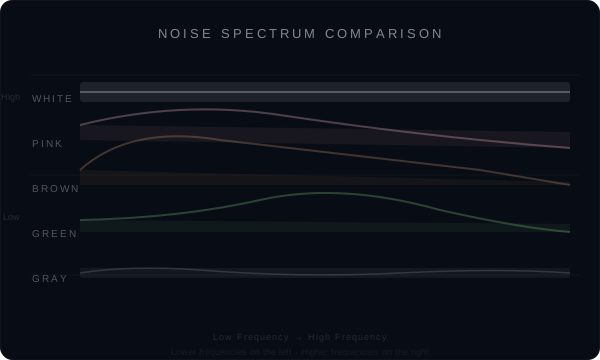
Over the last couple of years, I've tested pretty much all of them. I've fallen asleep to pink noise for weeks straight, used brown noise during stressful workdays, and even dabbled with gray noise when my tinnitus was acting up. Here's what I've learned — backed by actual science, not just marketing hype.
What Does "Color" Even Mean When We Talk About Noise?
Here's the simple version: the color of a noise describes where its energy lives across the frequency spectrum. Think of it like the color of light — white light contains all visible frequencies, and white noise contains all audible frequencies. Change the balance of those frequencies, and you get different colors.
Let's break each one down, from brightest to darkest.
White Noise: The Classic
White noise is what most people picture when they think of background sound — that steady "shhhhh" like an old analog TV between channels, a fan running on high, or static on the radio.
What it is: Equal energy across every frequency. All frequencies are represented at the same intensity.
Best for: Blocking out sudden noises. If you live on a busy street or have noisy neighbors, white noise is your best defense. Its flat spectrum makes it the most effective sound masker across the broadest range of frequencies.
What the science says: A 2021 meta-analysis of 38 studies found that white noise reduced the time it took ICU patients to fall asleep by an average of 38%. Another study from the University of Lincoln in 2024 confirmed that two weeks of nightly white noise use significantly improved sleep quality and reduced insomnia symptoms across 61 participants.
The downside: It can be harsh. That high-frequency hiss bothers some people, especially if they're sensitive to sound. I've had nights where white noise felt more irritating than relaxing.
Pink Noise: The Balanced One
Pink noise is what happens when you take white noise and turn down the treble. The higher frequencies are gentler, creating a sound that's warmer and more natural. Think steady rainfall, rustling leaves, or a distant waterfall.
What it is: Power decreases by 3 dB per octave as frequency increases. This creates equal energy per octave — which actually matches how our hearing works logarithmically.
Best for: Long-term listening, sleep, and focus. Pink noise is generally more pleasant to listen to for hours at a time compared to white noise.
What the science says: This is where things get interesting. Researchers at Northwestern University have been studying pink noise as a tool to enhance slow-wave sleep — the deepest, most restorative stage. Early results suggest that short pulses of pink noise synchronized with brain waves can improve memory consolidation by nearly 30%. The theory is that pink noise's frequency profile closely mirrors the distribution of brain wave frequencies during deep sleep.
Personal note: Pink noise is my personal favorite for everyday use. It's gentle enough that I forget it's playing after ten minutes, but effective enough that I notice the difference when I don't use it.
Brown Noise: The Deep Rumble
Brown noise takes the warmth of pink noise and pushes it even deeper. It's named after Brownian motion (the random movement of particles), not the color brown. Think distant thunder, crashing ocean surf, or the deep hum of an airplane cabin.
What it is: Power drops by 6 dB per octave — twice as steep as pink noise. Most of the energy lives in the low frequencies.
Best for: Anxiety, deep relaxation, and low-frequency masking. If you live near traffic with bass-heavy thumping sounds, brown noise can be a lifesaver.
What the science says: The 2024 University of Lincoln study mentioned earlier included brown noise in its comparison and found it equally as effective as white and pink noise for improving sleep quality. Anecdotally, brown noise has gained a massive following on platforms like TikTok and YouTube, where users describe it as "eargasmic" and report that it helps quiet their racing thoughts.
The downside: It can feel a bit oppressive for some people. That deep rumble isn't everyone's cup of tea, and on certain speakers or headphones, brown noise can sound muddy or distorted.
Green Noise: The Natural Middle
Green noise is the new kid on the block. It emphasizes the mid-range frequencies — roughly around 500 Hz — which is the range where many natural sounds live. Think ocean waves crashing, a babbling brook, or wind rustling through trees.
What it is: A boosted mid-frequency band, often described as "the background noise of the world." It's a relatively new term and the science is still catching up.
Best for: People who find white noise too harsh and brown noise too heavy. Green noise sits right in the middle and often feels the most natural to our ears.
What the science says: While dedicated green noise studies are still limited, Japanese researchers at the Japan Society of Mechanical Engineers found that natural wave sounds exhibit a 1/f frequency fluctuation pattern in the mid-range frequencies that induces a measurable relaxation response in EEG readings. This supports the idea that mid-emphasis sounds (which green noise approximates) are particularly effective for relaxation.
My take: Green noise is the most underrated of the bunch. It's not as famous as white or pink noise, but it deserves a spot in your rotation, especially if you're someone who finds most artificial noises grating after a while.
Gray Noise: The Psychoacoustic Equalizer
Gray noise is the most technically interesting of the group. It's designed to sound equally loud at all frequencies — taking into account how human hearing actually works.
What it is: White noise adjusted by an inverted equal-loudness contour (like an inverted Fletcher-Munson curve). This means it compensates for the fact that our ears are naturally less sensitive to very low and very high frequencies.
Best for: Tinnitus relief, sound sensitivity, and audiology applications. Because gray noise is perceptually flat, it's often preferred by people who find other noises unbalanced.
What the science says: Gray noise is used more in clinical audiology than in sleep research. It's commonly employed in hearing tests and tinnitus masking therapy because of its psychoacoustic properties. While there aren't large-scale sleep studies specifically on gray noise, the logic is sound — if a noise sounds perceptually balanced, it's less likely to become fatiguing over extended listening periods.
The catch: Gray noise can sound a bit odd at first, especially if you're used to white or pink noise. It has a subtle "scooped" quality that takes some getting used to.
How to Choose Your Noise Color
Here's a quick comparison table I wish I had when I started experimenting:
| Noise | Sounds Like | Best For | Try If |
|---|---|---|---|
| White | Fan, static, hissing | Maximum masking | You need to block out loud environments |
| Pink | Rainfall, leaves | Sleep & focus | You want something gentle for all-night use |
| Brown | Thunder, ocean, deep rumble | Anxiety relief | Racing thoughts keep you awake |
| Green | Ocean waves, wind, streams | Natural sound lovers | Artificial noises bother your ears |
| Gray | Balanced, full-spectrum | Tinnitus, sound sensitivity | You're sensitive to tonal imbalance |
What the Latest Research Says (Spoiler: Preference Matters More Than You Think)
A 2025 study from University College London published on bioRxiv measured pupil-linked arousal in 31 participants listening to white, pink, and brown noise at equalized volumes. The result? No measurable physiological difference between the noise colors. The researchers concluded that the benefits people experience from colored noise likely come from sound masking and individual preference rather than unique biological effects of each color.
This actually matches my experience after years of experimenting. What works best is the noise you personally find most pleasant and least distracting. The science supports the idea that all colored noises can help — but the specific color matters less than your personal comfort with it.
Here's my advice: don't overthink it. Try each one for a few nights. Notice which one you forget is playing after five minutes. That's the one for you.
One More Thing: Volume Matters as Much as Color
I made the mistake early on of cranking up the volume because I wanted maximum effect. Turns out that's counterproductive. The sweet spot for most people is around 45 to 55 decibels — about the level of a quiet conversation. Loud enough to mask external sounds, but quiet enough that you can still hear your own thoughts.
And please, use a timer. You don't need noise playing all night, especially not at higher volumes. Most studies use durations of 30 minutes to 2 hours.
Try all five noise colors for free
Try deepsleep →White · Pink · Brown · Green · Gray — all included, no sign-up