How I Beat Insomnia with 4-7-8 Breathing: Finding Your Anchor
I spent seven years afraid of my own bed.
That sounds dramatic, I know. But when you're an insomniac, the bedroom stops being a place of rest and becomes a stage for failure. Night after night, you lie down, turn off the light, and wait. Your brain, instead of quieting down, gets louder. You think about work. About that conversation from three years ago. About whether you'll be functional tomorrow on three hours of sleep. The panic builds, your heart races, and at some point you grab your phone and resign yourself to another four-hour night.
I tried everything. Melatonin, weighted blankets, cutting caffeine after noon, blue light glasses, fancy sleep teas named after things like "Tranquility" and "Moon Milk." Some of it helped around the edges. None of it fixed the core problem: I didn't know how to turn my brain off.
The thing that finally worked wasn't a product. It wasn't a supplement or a gadget. It was a breathing pattern I found in an article at 2:47 AM on a Tuesday, written by a Harvard-trained doctor named Andrew Weil. He called it the 4-7-8 breathing technique. He called it a "natural tranquilizer for the nervous system." I called it my last resort.
I had no idea it would change my life.
What Is 4-7-8 Breathing?
The mechanics are simple. You sit or lie down, and you breathe in a specific rhythm:
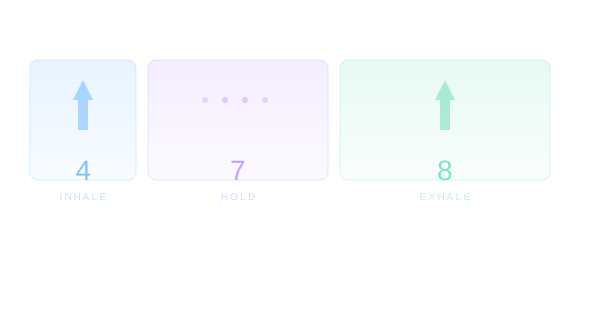
- Inhale through your nose for 4 seconds
- Hold your breath for 7 seconds
- Exhale slowly through your mouth for 8 seconds
That's it. Four seconds in, seven seconds held, eight seconds out. One cycle takes about 19 seconds. Do four cycles, and you've spent roughly 90 seconds resetting your nervous system.
But here's what I learned that no article told me: the numbers are a guide, not a rule. The real magic isn't in the counting. It's in how you breathe and where you put your attention.
The Science Behind Why It Works
The 4-7-8 technique works because it directly manipulates your autonomic nervous system — the part of your body that controls things like heart rate, digestion, and stress responses without you thinking about them.
Your autonomic nervous system has two main branches. The sympathetic system (often called "fight-or-flight") is what keeps you alert and reactive. The parasympathetic system ("rest-and-digest") is what helps you calm down, relax, and sleep. These two systems work like a seesaw: when one goes up, the other goes down.
The problem with insomnia is that the seesaw gets stuck. Chronic stress, anxiety, and overthinking keep your sympathetic system locked in the "on" position. Your body stays in a state of low-grade alertness, even when you're lying in bed in the dark. Your breathing becomes shallow and upper-chest. Your heart stays slightly elevated. Your brain keeps scanning for threats — except the threats aren't tigers, they're tomorrow's deadlines and awkward email drafts.
The 4-7-8 pattern breaks this loop by doing one very specific thing: it strongly stimulates the vagus nerve, the main cable that runs from your brainstem to your abdomen and acts as the control line for your parasympathetic system. The extended exhale (8 seconds) in particular sends a powerful signal through the vagus nerve that says "it's safe to power down."
Studies have confirmed this. A 2023 study in Cell Reports Medicine found that structured breathing exercises like 4-7-8 significantly improved mood and reduced physiological arousal. A 2025 study reported that regular practice dropped sleep quality scores from 13.33 to 4.93 on the Pittsburgh Sleep Quality Index. One retired judge with severe insomnia saw her anxiety scores drop from 24 to 11 after three weeks and called the technique "having a gavel for my thoughts."
But the science only explains the mechanism. It doesn't capture the experience. So let me tell you what it actually feels like.
Key 1: The Breath — Go Slower Than You Think Possible
My first attempt at 4-7-8 was a disaster. I lay on my back, counted obsessively, got dizzy, and felt like I was suffocating during the hold. I gave up after two cycles and went back to staring at the ceiling.
The problem was I was trying too hard. I was focused on getting the numbers right instead of understanding what the breathing was supposed to do.
Here's what I eventually figured out through weeks of practice. The most important instruction no one gives you: breathe as slowly as you possibly can.
Not the 4. Not the 7. Not the 8. Those numbers should feel effortless, almost too slow. If you're struggling, you're forcing it. Back off.
The breath hold is the most important part. When you hold, don't just sit there counting. Close your eyes and feel a ball of energy or warmth at the top of your head. That sensation of holding — that stillness — is where the real work happens.
Here's the visualization that finally made it click for me. On the inhale, imagine breath filling you from the belly up, like water rising in a glass. On the hold, feel that energy gather at the crown of your head — a pause, a stillness, a moment where nothing needs to happen. Then on the exhale, imagine that energy traveling slowly downward: from your head, down your neck, through your chest, your belly, your legs, all the way to your toes. The exhale should feel like a gentle release, not a forced push. And then on the next hold (after exhaling), you pause again — and this time, feel the energy settled at your feet, resting there for a moment before the next breath begins.
Inhale: energy rises. Hold: energy pauses at the crown. Exhale: energy descends, slowly, like a feather falling through water. Hold: energy rests at the soles, and you are still.
Then repeat. And repeat. And repeat.
Each cycle, your brain gets a little quieter. Each cycle, your body sinks a little deeper into the mattress. Each cycle, the space between your thoughts grows wider.
The key is not to force anything. The key is to be patient. Your mind will wander. That's normal. When you notice it wandering, gently bring your attention back to the breath. Not with frustration — with curiosity. "Oh look, I'm thinking again. That's interesting. Now back to the breath."
This is not a technique you master in one night. It's a practice. The first week, I felt nothing. The second week, I started noticing my body softening during the exhale. The third week, I fell asleep before finishing the fourth cycle for the first time in years. I cried. Not a lot, but a little.
Key 2: Finding Your Anchor
After a few weeks of consistent practice, something unexpected started happening. Somewhere around the third or fourth cycle, when my breathing had slowed down and my body had relaxed, I began to notice sounds I'd never heard before.
My heartbeat.
Not the dramatic, pounding-in-my-chest heartbeat you feel after running or during a panic attack. A softer one. A distant, rhythmic thump-thump coming from somewhere deep inside. It was always there — I'd just never been quiet enough to hear it.
Then I noticed my pulse in my hands. A subtle throbbing at my fingertips. Then in the back of my head, near where my neck meets my skull. A gentle, steady pulse, like waves lapping against a distant shore.
I had found my anchor.
What Is an Anchor?
In meditation and breathwork, an anchor is a fixed point of attention that you return to when your mind wanders. For some people, it's the sensation of breath at the nostrils. For others, it's the rise and fall of the belly. For me, it became the sound of my own heartbeat and the pulse running through my body.
The concept is simple: instead of trying to suppress your thoughts (which never works), you give your mind something to do — a single point of focus that's steady, rhythmic, and always available. Every time a thought pulls you away, you notice it, acknowledge it, and gently guide your attention back to the anchor.
Your heartbeat is perhaps the most powerful anchor you can find because it has three qualities that make it ideal:
- It's always there. You never lose it. You don't need an app, a podcast, or any external tool.
- It's perfectly rhythmic. The steady thump-thump gives your brain something predictable to lock onto, like a metronome for your nervous system.
- It's deeply internal. Listening to your heartbeat pulls your attention inward, away from external stimuli and mental noise. It connects you to the most fundamental signal of your own life.
Dr. Andrew Weil, the creator of the 4-7-8 technique, emphasizes that the method becomes more effective with practice. Unlike sleep medications that lose effectiveness over time, this technique actually strengthens with repetition. You're building what researchers call "vagal tone" — your nervous system's ability to shift from stress to relaxation. The more you practice, the faster and deeper the shift happens.
How to Find Your Own Anchor
If you're new to this, here's a practical approach. Start with the 4-7-8 breathing. Do 4-6 cycles. Don't worry about finding your anchor yet — just focus on the breath. Do this every night for at least a week. Build the habit first; the subtle sensations will follow.
After a week or two, start paying attention during the holds and the pauses between breaths. That moment of stillness at the end of the exhale — that's when your body is quietest. Listen in that silence. Don't search. Just listen. Eventually, you might notice a faint thumping, a subtle vibration, a sense of pulsation somewhere in your body. That's it. That's your anchor.
Once you find it, here's how to use it: during your breathing practice, after you've done a few cycles to settle in, let your attention drift from the breath to the pulse. Don't force it — just let it happen naturally. Focus on the sound of the beat. One beat. Then another. Then another. When your mind wanders (and it will), bring your attention back to the beat. Not with frustration — with patience. Every time you return, you're strengthening the neural pathway for calm.
One important thing I learned: in the beginning, the heartbeat or pulse anchor can be elusive. You might hear it for a minute, then lose it. That's completely normal. It doesn't mean you're doing it wrong. It means you're building a new skill. Like any skill, it requires practice. Don't chase the sound. Just stay still and wait. It will come back.
Ambient Sounds as an Alternative Anchor
Heartbeat meditation doesn't work for everyone, especially in the beginning. Some people find it too subtle or too abstract. If that's you, there's another option: use ambient sound as your anchor.
This is where deepsleep comes into the picture in a way I never expected. One night, I was struggling — my mind was particularly loud, and I couldn't settle into my breathing. Out of frustration, I opened deepsleep and put on ocean waves. Not to fall asleep to, but to have something to listen to — a focal point for my attention.
I synced my breath with the rhythm of the waves. Inhale as the wave built. Hold as it crested. Exhale as it receded and washed back out. The sound became my anchor — steady, predictable, always there. It was easier than finding my heartbeat because the sound was external and obvious. And once my mind locked onto it, the same thing happened: thoughts faded, my body relaxed, and I drifted off.
Different sounds work for different people. Ocean waves have a natural rhythm that's close to the human resting breathing rate. Rain sounds are more continuous and less rhythmic — better for people who find wave patterns distracting. White noise and pink noise provide a steady, featureless sound blanket that fills the silence without giving your brain anything to latch onto except its own quieting. Brown noise, with its deeper rumble, can feel almost like being held — a physical sensation of sound.
On the deepsleep app, I've found that brown noise works best as a meditation anchor for me — its deep, steady rumble gives my brain something solid to rest against. But on nights when I want a more structured rhythm, I mix ocean waves with a touch of wind. The combination creates a layered soundscape that's both grounding and gently dynamic — enough to hold my attention without overstimulating it.
Try Brown Noise on deepsleep → Ocean + Wind Mix →
The key, whether you use your heartbeat or an external sound, is consistency. Use the same sound night after night. After a while, your brain builds a Pavlovian association: this sound means sleep. The sound itself becomes the anchor, triggering the relaxation response before you've even taken your first deep breath.
What Six Months of Practice Looks Like
If you're reading this and thinking "that sounds like a lot of work" — you're right. It is. But here's what six months of consistent practice has given me:
- From 4-5 hours of broken sleep to 7-8 hours of solid sleep, most nights
- From 20-40 minutes to fall asleep to 5-10 minutes
- From waking up 2-3 times a night to 0-1 times
- From dreading bedtime to looking forward to it
- From lying in bed mentally rehearsing worst-case scenarios to lying in bed feeling my heartbeat and breathing slow down
I won't claim I'm cured. Insomnia isn't something you cure — it's something you manage. Some nights are still hard. Some nights, the thoughts come fast and loud, and no amount of breathing feels like enough. But those nights are the exception now, not the rule. And even on those nights, I have tools that work. I have an anchor.
The most important thing I've learned is this: you can't fight your way into sleep. Sleep isn't something you conquer. It's something you surrender to. The 4-7-8 breathing and the anchor aren't techniques to force sleep — they're tools to help you get out of your own way. They create the conditions for sleep to happen naturally, the way it's supposed to.
Your heartbeat has been with you every moment of your life, and it will be with you every moment until the end. It's the most loyal companion you'll ever have. Learning to listen to it — really listen — was the single most important skill I developed as an insomniac.
If you're lying in bed tonight, staring at the ceiling, feeling like you've tried everything: try this. Just the breath. Just the beat. Just one cycle. See what happens.
Find your anchor tonight
Try deepsleep free →Mix ocean waves, rain, white noise, and more · Free breathing guide included · No sign-up required